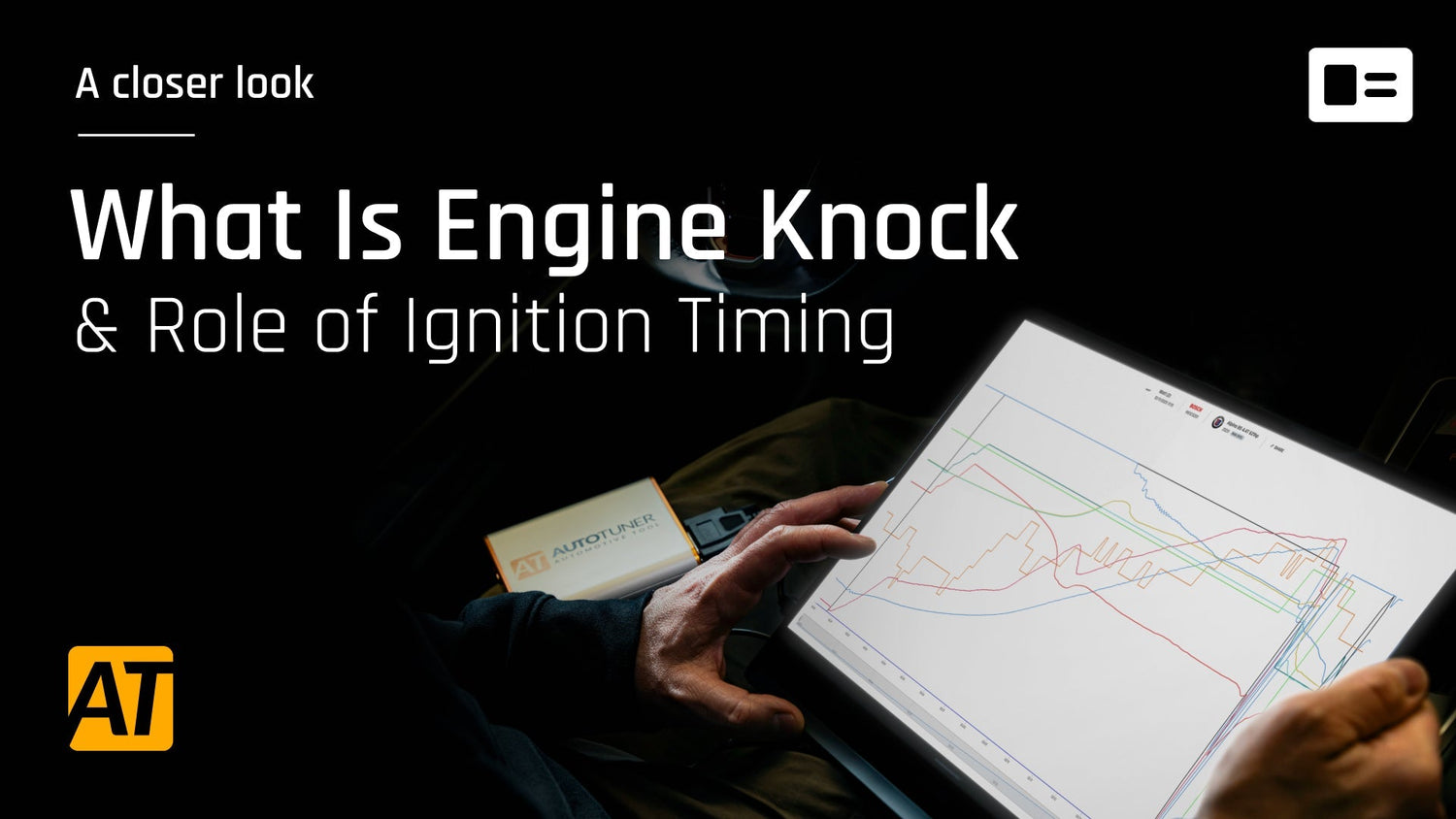
In the realm of internal combustion engines, few phenomena are as critical and widely misunderstood as engine knock, also known as misfiring. At its core, knock is a result of uncontrolled combustion that can have devastating effects on engine performance and longevity.
In this article, we’ll dive deep into what causes knock, how ignition timing influences it, and why this knowledge is essential for anyone tuning engines with tools like the AutoTuner ECU interface.
What Is Engine Knock?
Engine knock is the spontaneous combustion of the air-fuel mixture in the combustion chamber, occurring outside the controlled spark event. Instead of a smooth, flame-front propagation initiated by the spark plug, knock is characterized by pressure waves caused by pockets of unburned fuel-air mixture auto-igniting due to excessive temperature and pressure inside the combustion chamber.
These pressure waves resonate inside the cylinder, creating a characteristic metallic pinging sound, and more importantly some short and abrupt power cuts can be felt under load. Knock typically occurs under high-load, high-RPM conditions, where the piston speed and cylinder pressures and temperatures are high enough to exceed the auto-ignition threshold of the remaining mixture after spark ignition.
The Chemistry and Physics Behind Knock
Combustion in a gasoline engine is ideally initiated by a spark at a precise crank angle. The flame then propagates across the combustion chamber in a controlled manner. But if the gasoline-air mixture temperatures rise too high before the flame front reaches them, the unburned mixture can spontaneously ignite.
Key contributing factors include:
- High intake air temperatures
- High cylinder pressures (from boost or compression)
- Lean air-fuel mixtures
- Low-octane fuels
- Over-advanced ignition timing
The result is a sudden, explosive release of energy, rather than the uniform expansion desired from controlled combustion.
The Role of Ignition Timing
Ignition timing refers to when the spark plug fires in relation to the position of the piston. It’s usually measured in crankshaft angle degrees Before Top Dead Center (BTDC), so before the piston reaches the top of the cylinder, where maximum compression occurs.
Optimal timing ensures the pressure peak from combustion occurs slightly after TDC, when the piston is just beginning its downward power stroke. This maximizes torque output without subjecting the engine to undue stress. A common misconception is that combustion is instantaneous, which it isn’t. It takes a certain amount of time for the flame to propagate within the cylinder, which means the spark must ignite the mixture before TDC for the peak combustion pressure to occur after TDC, when the piston travels downwards. This also means that there is a linear relationship between engine speed (and thus piston speed) and optimal ignition advance. The faster the piston moves, the earlier the mixture must be ignited to ensure combustion occurs while the piston travels downwards.
But here’s the catch: advancing timing (firing the spark earlier) can improve power—up to a point. Beyond that, it increases the likelihood of knock, especially under load. Conversely, retarding timing reduces the risk of knock but at the expense of power and efficiency.
This is where modern ECUs play a critical role. They dynamically adjust ignition timing based on:
- Engine load
- Boost pressure
- Air-fuel ratio
- RPM
- Intake air temperature
- Knock sensor feedback
- Fuel quality (octane rating)
For the best performance, the responsible maps in the ECU must be carefully calibrated to avoid engine knock.
Active Knock Control and Tuning
Most modern ECUs use knock sensors, usually piezoelectric accelerometers mounted on the engine block to detect the frequency signature of detonation. When knock is detected, the ECU will retard ignition timing (decrease ignition advance) to reduce cylinder pressure and protect the engine.
While this is a great safety mechanism, it comes at a cost: timing retard reduces torque and efficiency. Ideally, you want to tune the engine so that knock never occurs in the first place under expected operating conditions, allowing the engine to run at or near maximal torque timing.
When recalibrating the ignition strategy, professionals can access and adjust:
- Ignition maps based on:
- engine load
- boost pressures
- lambda
- RPM
- etc.
- Octane-specific maps
- Knock control thresholds
This level of control allows fine-tuning the ignition strategy to specific fuels (e.g., 98 RON vs. E85) and many more customizations the client might want.
Knock and Forced Induction
Forced induction, like turbocharging and supercharging, dramatically increases air density, combustion pressure, and temperature, all of which raise the knock risk. This is why boosted gasoline engines are so timing-sensitive.
Tuning for boost requires a nuanced understanding of:
- Charge temperature management (intercoolers, water-meth injection)
- Octane requirements
- Boost-to-timing compensation
- Closed-loop knock adaptation
A common strategy is to run richer air-fuel ratios under boost, which cools the combustion charge and slows flame speed, giving more leeway in ignition timing. Tuners can implement load-based ignition retard curves, ensuring that timing is dynamically reduced at higher manifold pressures while maintaining good drivability at part load.
Diesel Engines and “Knock”
While engine knock is detrimental to gasoline engines, Diesel engines rely on a form of knocking for combustion. Unlike spark-ignited gasoline engines, Diesels use compression ignition: air is compressed to extremely high pressures and temperatures, and fuel is then injected directly into the hot, compressed air. The fuel auto-ignites, which is, by definition, knocking.
The key difference is that Diesel engines are designed for this. They manage the auto-ignition event through:
- High compression ratios (typically 16:1 to 20:1)
- Precise fuel injection timing
- Multiple injection events (pilot, main, post)
- Combustion chamber geometry tailored to swirl and turbulence
Modern Diesel ECUs, especially on common-rail systems, provide exquisite control over injection parameters. Using AutoTuner, a technician can calibrate:
- Injection timing maps
- Injection quantity and pressure
- Pilot injection strategies to soften knock intensity
By controlling these variables, a Diesel can be tuned to balance power, emissions, and combustion noise, all of which are affected by knock intensity.
Summary: Knock Tuning Requires Precision
Whether it’s being suppressed in a gasoline engine or harnessed in a Diesel, knock is a fundamental part of combustion dynamics. The ability to precisely control ignition timing based on load, RPM, temperature, and fuel quality is what separates a robust tune from one that risks piston failure.
With tools like AutoTuner, professionals can extract the deep-level maps and strategies from modern ECUs, allowing them to safely recalibrate the ECU to extract more power, improve efficiency, and protect engine hardware.
Ultimately, tuning ignition is not just about power, it’s about control. And in the battle against knock, control is everything.